Wednesday, August 13, 2014

Cumpleaños de Mons. Romero en clave de solidaridad


El Viernes, 15 de agosto 2014, la Comunidad de San Egidio de Roma encabezará un servicio de oración en la Basílica de San Bartolomé en la Isla Tiberinaun santuario a los mártires modernos de la Iglesiapara mostrar su solidaridad con los cristianos perseguidos de Irak y el Medio Oriente. Ese mismo día se conmemorará el 97° aniversario del nacimiento del arzobispo mártir Mons. Oscar A. Romero de El Salvador, cuyo libro de oraciones se mantiene como una reliquia en esa iglesia. Este año, el cumpleaños de Romero llega en medio de un renovado clima de persecución cristiana y su conmemoración ofrece una ocasión solemne para la solidaridad, la oración, y la denuncia profética de estas situaciones injustas.

Aquí tres puntos para la reflexión y la oración:

En primer lugar, la vida y el ejemplo de Mons. Romero se convierten en un punto claro de referencia, que demuestra que la persecución y el martirio siguen siendo vigentes para la Iglesia. Antes de convertirse en una víctima de la persecución de la iglesia, Romero era una voz valiente de denuncia de las políticas de la represión que tuvieron como objetivo su Iglesia. “La persecución es una realidad que es necesaria para la Iglesia”, declaró. “¿Saben por qué? Porque la verdad es perseguida. Jesús dijo a sus discípulos: Si me persiguieron a mí, también a vosotros os perseguirán (Juan 15:20)” (Homilía del 29 de mayo 1977.) Recordó el corolario del Papa León XIII a las conocidas Cuatro Notas de la Iglesia—es Una, Santa, Católica y Apostólica yo añadiría otra: perseguida” (Ibíd.) “Una Iglesia que no sufre la persecución no es la verdadera Iglesia de Jesucristo”, declaraba Romero (Hom. 11 de marzo 1979. ) “Gracias a Dios”, dijo Romero, “no sólo somos conscientes de las historias de los mártires de los siglos pasados​​, pero también somos conscientes de los mártires de nuestro tiempo”. (Hom. 14 de abril 1979.) Por ejemplo , “el Cardenal Wojtyla nos recuerda los tiempos de las catacumbas y las épocas del circo [romano]”, dijo Romero: “los tiempos de los mártires”. (Hom. 29 de octubre 1978.) Romero siempre se unió en solidaridad cuando los Papas de su tiempo pidieron oraciones por el conflicto en Tierra Santa y en la región.

En segundo lugar, estamos viviendo un momento que llama a la oración y la solidaridad. El viernes 15 de agosto, la Iglesia italiana celebra su Jornada de oración por los cristianos perseguidos. El sábado 16, el Papa Francisco proclamará beatos a 124 mártires en Corea, una ocasión que seguramente le recordará al mundo de la situación urgente de los cristianos en el Medio Oriente y en otras zonas de conflicto. El domingo 17 es el día que los obispos de Estados Unidos han pedido oraciones por las persecuciones de los “Nazaris” (los cristianos) en Irak. Los católicos filipinos están instados a hacer el lunes 18 de agosto un día de oración por la paz en Irak. En suma, si el tema de los tiempos comprueba la relevancia de Mons. Romero, también podemos decir que la memoria de Romero se debe considerar en una clave de solidaridad y de la oración, que ayuda a la reflexión recuperar la plenitud e importancia de su significado.

Por último, también se puede unir nuestra reflexión con una profunda contemplación de la Fiesta de la Asunción, y la figura de la Madre de Cristo, que asciende al cielo en el amanecer de aquella primera época de mártires. Sin embargo, la ascensión no fue de ninguna manera una alienación: la Madre de Dios no abandona a la Iglesia al inicio de aquella tribulación. En cambio, María se convierte en una luz que guía desde lo alto, una antorcha que ofrece una perspectiva de trascendencia, y por lo tanto puede dar un nuevo impulso e inspiración para los fieles. En las palabras de Mons. Romero, “Tras la noche ya fulgura la aurora, ya se lleva en el corazón la esperanza que no falla. ¡Va Cristo con nosotros! No temamos”.

Que tengan una bendita Fiesta de la Asunción, en que se conmemora el 97° aniversario del natalicio de Oscar Romero. Pidamos su intercesión por nuestros hermanos y hermanas cristianos que sufren persecuciones hoy en día.

Compleanno di Mons. Romero in chiave di solidarietà


Il Venerdì, 15 Agosto 2014, la Comunità di S. Egidio di Roma porterà un servizio di preghiera nella Basilica di San Bartolomeo all'Isola Tiberinaun santuario ai martiri moderni della Chiesaper mostrare solidarietà con i cristiani perseguitati in Iraq e nel medio Oriente.  Quello stesso giorno segnerà il 97 ° anniversario della nascita del martire Mons. Oscar A. Romero di El Salvador, il cui libro di preghiera è una reliquia in questa chiesa.  Quest'anno, il compleanno di Romero viene in mezzo di un nuovo clima di persecuzione cristiana e la sua commemorazione fornisce un'occasione solenne per la solidarietà, per la preghiera, e per la denuncia profetica di quelle situazioni ingiuste.

Ecco tre punti per la riflessione e per la preghiera:

In primo luogo, la vita e l'esempio di Oscar Romero diventano un punto di riferimento chiaro, che dimostra che la persecuzione e il martirio continuano ad essere rilevanti per la Chiesa. Prima di diventare egli stesso una vittima di persecuzioni della chiesa, Romero era una voce coraggiosa di denuncia delle politiche di repressione che hanno colpito la sua Chiesa.  La persecuzione è una realtà necessaria per la Chiesa”, ha dichiarato. “Sapete perché? Perché la verità è perseguitata. Gesù disse ai suoi discepoli: Se hanno perseguitato me, perseguiteranno anche voi (Gv 15,20)”. (Omelia 29 maggio 1977.) Ha ricordato il corollario di Papa Leone XIII per gli quattro caratteristiche della ChiesaUna, Santa, Cattolica, e Apostolicavorrei aggiungere un altra: perseguitata” (Ibid.). Romero ha dichiarato: “Una Chiesa che non soffre la persecuzione non è la vera chiesa di Gesù Cristo”. (Om. 11 Marzo 1979.) “Grazie a Dio”, ha detto Romero, “non solo siamo consapevoli delle storie dei martiri di epoche passate, ma siamo anche consapevoli dei martiri del nostro tempo”. (Om. 14 Aprile 1979.) Ad esempio , “il cardinale Woytila ​​ci ricorda i tempi delle catacombe e tempi del circo [romano]”, ha detto Romero: “i tempi dei martiri”. (Om. 29 ottobre 1978.) E Romero ha stato sempre unito nella solidarietà quando i Papi del suo tempo chiesto preghiere per in conflitto in Terra Santa e la regione.

In secondo luogo, stiamo vivendo un momento che richiede la preghiera e la solidarietà. Venerdì 15 agosto, la Chiesa italiana sta tenendo la sua Giornata di preghiera per i cristiani perseguitati.  Il Sabato 16, Papa Francesco celebrerà la beatificazione di 124 martiri in Corea, un'occasione che sicuramente ricordarà al mondo la situazione urgente per i cristiani in Medio Oriente e in altre zone di conflitto.  Domenica 17 è il giorno i vescovi degli Stati Uniti hanno chiesto preghiere per le persecuzioni dei “Nazari” (i Cristiani) in Iraq.  Cattolici filippini sono stati invitati a fare il Lunedi 18 agosto una giornata di preghiera per la pace in Iraq.  In somma, se il tema dei tempi dimostra la pertinenza di monsignor Romero, possiamo anche dire che la memoria di Romero deve essere considerata in chiave di solidarietà e di preghiera, che aiuta la riflessione recuperare la pienezza del suo significato e sua importanza.

Infine, possiamo anche unire nostra riflessione con profonda contemplazione della festa dell'Assunta, e la figura di una madre di Cristo che ascende al cielo all'inizio di quella prima epoca di martiri.  Tuttavia, quella ascensione non era affatto una alienazione: la Madre di Dio non abbandona la Chiesa al momento della comparsa di quella tribolazione.  Invece, Maria diventa una luce che guida dall'alto, una torcia che fornisce una prospettiva di trascendenza, e quindi è in grado di dare un nuovo impulso e ispirazione per i fedeli.  Nelle parole di Oscar Romero, “Dopo la notte brilla già l'alba, e ci portiamo nei cuori la speranza che non delude. Va Cristo con noi! Non abbiamo paura!

Buona festa dell'Assunta, che segna il 97 ° anniversario della nascita di Oscar Romero. Chiediamo la sua intercessione per i nostri fratelli e sorelle cristiani che soffrono persecuzioni oggi.

Friday, August 01, 2014

Romero at 97


Español | italiano
August 2014 will mark the 97th anniversary of the birth of Archbishop Óscar A. Romero, the martyred Salvadoran cleric said to be close to beatification under Pope Francis.  For the Salvadoran Church, the date will start a three-year countdown to the Romero Centennial, which church authorities hope will (finally) bring canonization of the Salvadoran martyr.
Last year, Tim’s El Salvador Blog compiled a list of Romero resources that Super Martyrio wishes to repeat and supplement here.  Here are Tim’s selections:
[* August will also mark the 25th anniversary of the release of the Raul Julia film and I will post something relative to that film and its legacy later this month.]
Here are my additions:

The Best of this Blog.  Finally, here is a recap of my most essential posts.
  1. «Romero for Dummies».  My attempt to offer a cheat-sheet intro to the man, his legacy, and his cause.
  2. Septem Sermones Ad Pauperem.  Four-year running Lent ruminations on Romero’s final sermons, which summarize the teachings of a lifetime—and cost him his life.
  3. «Homiliarium».  All of Romero’s homilies on a single page, English and Spanish, audios, transcriptions, and translations, by liturgical cycle.  Might be the single most useful post here.
  4. Recaps of Romero’s pastoral letters, beginning with his last.
  5. The latest on the beatification cause.  There was some premature excitement earlier this year, summarized here.
  6. Romero in Rome.  A nostalgic look back at Romero’s seminary years shows how his time in Rome foreshadowed his prophetic ministry as Archbishop of San Salvador.
  7. The Liturgical Style of Óscar Romero.  Another Super Martyrio original that you won’t find anywhere else, shows how Romero tried to balance tradition and innovation.
  8. «Rosarium».  This is a Rosary that I will pray through August, the month of the Assumption of Mary, which focuses on Romero’s devotion to the Eucharist.
  9. Series on Romero and the Popes.  Various posts on Romero’s relationship with and fidelity to the modern popes.  Here is the post regarding St. John Paul II.
  10. Series on Romero and Contemporary Catholics.  Various posts situate Romero in the mainstream of the Church.  Here is Romero and St. Josemaría Escrivá, of Opus Dei.
With that, I hope you have some useful tools with which to commemorate the 97th anniversary of the birth of Oscar Romero, and to begin the countdown to the centennial year.

Sunday, July 13, 2014

Vacation meditation


A thought exercise regarding Óscar Romero and St. Damien of Molokai.


Photo credit: TripAdvisor.com, user Alienpilot, May 2012.


Español | Italiano

Staring intently at the sun setting behind Molokai, from Maui, where I was on vacation with my family this summer, was, for me, a religious experience (the two Hawaiian islands are only 7.5 miles apart).  The sunset has since time immemorial been a spiritual hour for Christians: the Vespers have been recited at this time since at least the 4th century; the glorious refraction of the sun’s light across the sky creates a natural stained glass window, and the fall of darkness recalls the hour of the death on the Cross.  Going on vacation can take us out of our normal schedule, threatening to disrupt our prayer life.  But powerful moments such as the sunset—which happens every day, and being on vacation may leave us more at liberty to observe—can provide an opportunity to keep up our prayer life and indeed enrich it.

One way to seize upon such unplanned and unexpected moments is meditation—that “freestyle” form of conversation with God, which differs from regular prayer in that prayer attempts to articulate in words our needs and praise, while meditation “engages thought, imagination, emotion, and desire.”  [Catechism of the Catholic Church, §2708.]  It is often said that meditation in the Christian sense involves an active process—engaging the mind through thought, imagery, reflection, etc.—whereas “eastern” forms of meditation often involve “emptying” oneself of these.  Catholics may turn to these other techniques for “a path to interior peace and psychic balance,” but they are not effective substitutes for prayer. [Letter to the Bishops on Some Aspects of Christian Meditation, Congregation for the Doctrine of the Faith, J. Ratzinger, Prefect, 1989.]  Christian prayer should go further: to the knowledge of the love of the Lord Jesus, to union with Him.”  [Catechism, supra.]

In my meditation as I marveled at the miraculous sunset over Molokai, my thoughts turned of course to St. Damien, the Belgian priest who ministered to the leper colony that was once established there, and his unconditional commitment to Christ through the lepers.  So great was his submission that he was known as “the Martyr of Molokai,” in no small measure because of the fact that Father Damien ended up contracting leprosy himself and dying.  According to the modern Salvadoran martyr Óscar Romero, Father Damien’s commitment can only be understood through the prism of the Eucharist: “The bread of eternal life gave Father Damien strength, gives strength to every missionary, to all sisters, to all priests, gives life to the ecclesial base communities, and becomes the center of parish life,” Romero said.

The resulting thesis from my meditation staring at the sun set over Molokai became: (1) how similar Romero and St. Damien were in their commitment to Christ through contemporary outcasts; (2) how similar the medical apartheid of Molokai was to the injustice that Romero confronted; and (3) how both St. Damien and Romero were motivated by a missionary impetus that is vital to the Church’s mission (read: our mission) today.

The similarities between Óscar Romero and St. Damien of Molokai are quite remarkable and become clear if we consider a few choice snippets from the words of the two men.  My greatest pleasure is to serve the Lord in his poor children rejected by other people,” said St. Damien.  One day as he raised up the consecrated host,” Romero said of Damien, “he saw on his hand the signs of leprosy and from that time on when he spoke with the lepers he said: we, lepers.” 

St. Damien described his internal attitude this way: “Having no doubts about the true nature of the disease, I am calm, resigned, and very happy in the midst of my people.”  The same serenity comes through from Óscar Romero a month before his assassination: “Believe me, sisters and brothers, anyone committed to the poor must suffer the same fate as the poor.  And in El Salvador we know the fate of the poor: to be ‘disappeared,’ to be tortured, to be jailed, to be found dead.”  Again, St. Damien: “God certainly knows what is best for my sanctification and I gladly repeat: Thy Will Be Done.”  And Óscar Romero: “Thus do I place under His loving providence all my life, and I accept with faith in Him my death, however hard it be.  I do not want to express an intention to him, such as that my death be for my country’s peace or our Church’s flourishing.  Christ’s heart will know how to direct it to the purpose He wishes.”

If the attitudes of the two men were similar, the environmental conditions that produced them were also alike.  In nineteenth century Molokai, legislation made it a crime to be a leper and consigned those poor wretches suspected of having the disease to banishment upon a thin strip of land nestled between the Pacific Ocean and the tallest sea cliffs in the world—which Robert Louis Stevenson called “a prison fortified by nature.”  Those confined there lost all legal rights and were considered legally dead to the world.  It was the 1800s version of apartheid.  In 1970s El Salvador, a modern military state was set up to enforce a society with the socioeconomic distribution of a medieval fiefdom.  The military repression there was worse than that in Pinochet’s Chile or Argentina during the ‘Dirty War.’

Facing both situations, St. Damien and Óscar Romero made what would be called in modern theological parlance a “preferential option for the poor.”  In our hyper-politicized times, such terms immediately invoke suspicions.  Speaking about St. Damien, Archbishop Romero remarked that “Some people cannot conceive of women and men willing to die unless it is for some subversive or revolutionary motive.”  He went on: “But there is a power greater than any revolution: the love that individuals and communities have discovered in the treasure that is revealed to us in Jesus Christ—his lively and life-giving presence in the Eucharist.”  St. Damien said the same thing in fewer words: “I make myself a leper with the lepers to gain all to Jesus Christ.”

These last words reflect an evangelizing, missionary thrust behind St. Damien, which was also found in Archbishop Romero.  Father Damien went to the lepers because he wanted to win their souls for the Kingdom: “The harvest appears to be ripe here.”  Similarly, Archbishop Romero targeted social reformers and those seeking to establish earthly justice as potential targets the Church might win over to what he considered to be the greatest liberationist project of all—Christ’s deliverance found through the Church’s ministry of salvation.  In this way, both men were trying to do what Pope Francis would call going to the existential peripheries of modern life to bring the gospel message to groups that have not heard it.  Accordingly, both men are exemplars of how we need to take the gospel to groups that have heretofore evaded targeting, boldly going where no evangelist has gone before.

My actual meditation as I beheld the magnificent sunset over Molokai was, of course, more modest than this effort to corroborate the underpinnings of my reflection.  Nevertheless, the bones of the foregoing rumination were all there, and I was able to contemplate in relation to the celestial spectacle how two different men, living in different times and circumstances, were able to, like rays of the same sun, converge upon a singular focus: Christ Jesus.  As all Christian meditation does. 

Meditation, a method of encountering God that is more flexible and adaptable because it engages the imagination rather than the deliberate word, can be an important way of keeping our channels of communication with God open while we are on vacation.  In fact, the opportunities presented during these moments of leisure can provide unexpected little epiphanies and revelations that may flourish from the everyday picture cards of nature—for the aides to Christian meditation include “the great book of creation, and that of history the page on which the ‘today’ of God is written.” [Catechism, supra, §2705.]

Wednesday, July 02, 2014

Ma Ying-jeou


Photo Kelly Mazariego on Twitter: @kmazariegoTCS


The President of the Republic of China (Taiwan) Ma Ying-jeou and his entourage make a deep bow before the Tomb of Archbishop Óscar A. Romero in the Crypt of the Metropolitan Cathedral of San Salvador, El Salvador on Wednesday, July 2, 2014.  President Ma is in El Salvador on an official visit.  The government of Taiwan recently donated funds to bring a statue of Archbishop Romero to Rome, Italy.  Ma is the latest in a growing list of Heads of State to visit the Tomb of Archbishop Romero during a visit to El Salvador. The most prominent of all the others has been Barack Obama in 2011.


El Presidente de la República de China (Taiwán), Ma Ying-jeou y su comitiva hace una solemne reverencia ante la tumba de Mons. Óscar A. Romero en la cripta de la Catedral Metropolitana de San Salvador, El Salvador el Miércoles, 2 de julio 2014 . El Presidente Ma se encuentra en el Salvador en una visita oficial. El gobierno de Taiwán donó recientemente fondos para traer una estatua de Mons. Romero a Roma, Italia.  Ma es el último de una larga lista de jefes de Estado de visitar la tumba de Monseñor Romero durante una visita a El Salvador. El más prominente de todos los demás ha sido Barack Obama en 2011.

Il Presidente della Repubblica di Cina (Taiwan) Ma Ying-jeou e il suo entourage prendere un profondo inchino davanti alla tomba di Mons. Oscar A. Romero nella Cripta della Cattedrale Metropolitana di San Salvador, El Salvador Mercoledì 2 Luglio 2014. Il Presidente è in El Salvador in visita ufficiale. Il governo di Taiwan ha recentemente donato fondi per portare una statua di Mons. Romero a Roma, Italia.  Ma è l'ultimo di una lista crescente di capi di Stato a visitare la tomba di Mons. Romero durante una visita a El Salvador. Il più importante di tutti gli altri è stato Barack Obama nel 2011.


Sunday, June 29, 2014

Romero in the Age of Francis


Francis addresses Brazilian slum with giant Romero painting overhead;
Francis blesses likeness of Romero presented by the faithful;
Romero banners at Francis' «Angelus» event at the Vatican.
Español | Italiano

Let’s be frank: Pope Francis is the best thing to happen for Óscar Romero.  But let’s also be clear: the reason why Francis is so good for the memory of the slain Salvadoran archbishop (1917-1980) is not that Francis has advanced Romero’s beatification cause (though he has) or that Francis has validated Romero by taking social stances reminiscent of Romero (though he has also done that).  The greatest thing Francis has done for Romero is to attract the contempt of the right, showing the world that being painted as a Marxist for espousing the social gospel is badge of honor, not a cause of shame.

Beatification “unblocked”

Romero supporters have much to be thankful for in Francis’ pontificate so far.  Cardinal Jorge Mario Bergoglio’s views about Romero were known in the inner circles before he was even Pope.  In May 2007, Cardinal Bergoglio told a Salvadoran cleric, “If I had been pope, the very first thing I would have done is order the beatification of Archbishop Romero.”  According to reports, the Argentine had come in second behind Joseph Ratzinger in the 2005 conclave.  But on March 13, 2013, the Argentine became Pope Francis, and on April 20 he let it be known that he had “unblocked” the Romero beatification.

During his years as Archbishop of Buenos Aires, Card. Bergoglio attended several ceremonies paying tribute to Archbishop Romero in events organized by the Sant Egidio community of Argentina, in the framework of the ecumenical commemoration of twentieth century martyrs. For example, in the 2005 commemoration of Romero and others, held at the Buenos Aires Cathedral, Card. Bergoglio railed against the “greatest evil that can happen to the Church of the Lord: spiritual vulgarity—when we enter into accommodations with the schemes of this world.” When Card. Bergoglio led a delegation of Argentine bishops to Rome in 2009, they visited the Basilica of St. Bartholomew on Tiber Island, which pays tribute to twentieth century martyrs, including Archbishop Romero.

In the year that he has been Pope, Francis has continually discussed Romero and his beatification with a long line of visitors.  For example, in the days around his inauguration, Francis received several guests who took up Romero with the new pope, including the Anglican archbishop of York John Sentamu, who handed Pope Francis a "Romero Cross" like the one Sentamu wears.  In those first months, Francis met twice with the Argentine Nobel Peace laureate Adolfo Pérez Esquivel, and they discussed Romero and the desirability of a positive result in his canonization process.  That specific topic—Romero and his canonization process—took center stage in several high profile meetings, including with Salvadoran president Mauricio Funes, with his successor Salvador Sánchez Cerén, and with the President of the Central American Parliament who Francis assured that the canonization is “on the right path.”

When Pope Francis received a high ranking delegation of Salvadoran bishops last month, and the topic of discussion was, again, Archbishop Romero, there were widespread rumors that a beatification announcement was imminent.  Although that ultimately turned out to be premature speculation, it showed how high the expectations for Romero have risen under this pontificate, where a year before Francis’ election, the prospect of Romero’s sainthood was being sized up by Vatican-watchers as a “lost cause.”

‘A poor Church, for the poor’

The elevation of the first Latin American to the See of Peter represented a tectonic shift for the Church—and for the Romero cause.  As explained by Italian Cardinals Achille Silvestrini and Andrea Cordero Lanza di Montezemolo, Romero symbolizes “the Church that Pope Bergoglio wants to project to the geographical and existential peripheries” in this Pontificate and there is “an identity of thinking” between Archbishop Romero and the new Pope, who announced he would like to see the Catholic Church be “a poor Church for the poor.”

The Argentine Pontiff has said that he chose the name “Francis,” in honor of St. Francis of Assisi, because of the beloved saint’s association with the poor and the environment.  How I would like a Church which is poor and for the poor!,” he declared within days of being elected. For his part, Romero is best recalled as a champion of the poor, who sought to be the voice of the voiceless: “We are never ashamed to say the Church of the poor,” he insisted.

Because Francis hails from Latin America, says Honduran Cardinal Óscar Andrés Rodríguez Maradiaga, a close advisor to the Pope, he knows how the other half lives.  For us, poverty is concrete people, concrete faces of people — people who suffer, people who are living in slums, people who are in prison, people who are deported, people who are in refugee camps,” says the prelate.  Cardinal Rodríguez, an avowed Romero admirer, says that it was “the constant seeking of the will of God that led him to face bravely the structural sin that was crushing the little ones of his dear country.”  According to the Honduran cardinal, “Francis analyzes the economy from the point of view of the poor which is in line with Jesus’s perspective.”  Moreover, says Rodríguez, “Francis recognizes in those unjust structures an illness of the system as such.”  An illness which the Pontiff—like Archbishop Romero—consistently denounces.

‘If the world hate you, it hated Me before it hated you…’

Perhaps the greatest validation Pope Francis has brought to Archbishop Romero is to put the slanders against the Salvadoran martyr in context in the way that the Pontiff has become a lightning rod for ideologues.  For years, the greatest stumbling block in Romero’s path to beatification was the perception that he was Marxist-tainted or affiliated with the “socialist” current of Liberation Theology.  Francis has largely obliterated that stain by showing that ideological critics will bristle even at fair criticism of capitalism (they had similarly attacked Paul VI), and are not too shy to attack even the Pope.

The American conservative radio talk show host Rush Limbaugh dismissed Pope Francis’ criticism of capitalism as “pure Marxism coming out of the mouth of the pope.”  Limbaugh accused Francis, among other things of using Marxist terms like “unfettered capitalism” to describe the world economy.  Unfettered capitalism?  That doesn’t exist anywhere.  Unfettered capitalism is a liberal socialist phrase to describe the United States.”  Even a Harvard University’s Kennedy School of Government scholar criticized Francis for supposedly “promoting envy” of the rich while discouraging entrepreneurship and innovation. “Encouraging people to measure themselves against others only leads to grief,” wrote Lant Pritchett. “Resenting the success of others is a sin in itself.”  Similarly, Loyola Marymount (a Catholic institution) professor David Byrne admitted that he “cringed” at the echoes of Liberation Theology in the Pope’s exhortation «Evangelii Gaudium».

Of course, rightwing extremists had branded Romero (whose middle name was Arnulfo—after St. Arnulf of Soissons, upon whose feast day he was born) “Marxnulfo” and accused him of everything from stirring up class hatred to actively leading a Communist rebellion (seriously).  The smears have nothing to do with truth or honest analysis, and everything to do with the sting when denunciation strikes a chord:

If the world hate you, know that it hated Me before it hated you.  If you were of the world, the world would love its own, but because you are not of the world, but I have chosen you out of the world, therefore the world hates you.” (John 15:18-19.)

In light of these words of Jesus, the revulsion from certain quarters inspired by Romero and the Pope are no cause for shame, but rather they are confirmations of authenticity and badges of courage.  By attracting the same venom and contempt as the abused Salvadoran, Pope Francis is helping the Catholic world to understand Romero.

Lessons from the Latin American Church


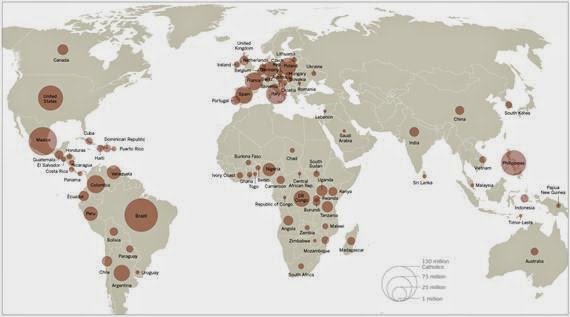
Global distribution of Catholicism, (c) Pew Research Center, 2010.


Español | Italiano

The Traditionalist site Rorate Cæli recently diagnosed “the collapse of Catholicism in Latin America” and attributed the downfall to the Second Vatican Council and to the brand of Catholicism espoused by Latin American clerics such as Pope Francis.  Not only is the analysis wrong about the perceived failure of Latin American Catholicism, but it risks leading readers to miss the valuable lessons that the greater Catholic world can learn from the Latin American Church—lessons that Pope Francis has begun to implement at the Vatican.

Ironically, the Rorate analysis is wrong, in part, because it engages in a type of thinking specifically condemned by Latin American ecclesiology and criticized by Pope Francis—a kind of self-absorbed way of looking at the world that the Pope calls being “self-referential.”  In a speech before he became Pope, then Cardinal Jorge Mario Bergoglio said that, “The evils that, over time, happen in ecclesial institutions have their root in self-referentiality and a kind of theological narcissism.”  It requires “self-referentiality” to conclude that the downward trends in Latin American Catholicism were caused by the Second Vatican Council—ignoring similar trends worldwide at the same time among many other religions.  The web site, keen on the use of Latin, also falls into the fallacy that is still known by its Latin handle: Post hoc ergo propter hoc (“after this, therefore because of this”)—the folly of thinking that because something happens later in relation to something else, that the first thing causes the second.  Rorate reasons: (a) Vatican II occurred in the 1960s; (b) the 13 point drop in Latin American Catholicism for 1995-2013 postdates Vatican II; therefore (c) Vatican II caused the 13 point drop.  In fact, the trends observed during the period in question have been in motion for much longer than said period and predate the Council.

The Rorate analysis contains other errors, including selective application of its hypothesis, for example, citing figures showing decline to thrash favorite whipping boys, like Honduran Cardinal Rodríguez Maradiaga, but not attributing responsibility for (or otherwise addressing) similar downward trends when they implicate conservatives.  The analysis is sometimes downright misleading, for example stating that losses in El Salvador are attributable to Liberation Theology, when a conservative, Opus Dei archbishop was in place there during the period in question.  Conversely, the Rorate piece does not “credit” successes that, under their logic would be attributable to progressives: the best performance stats go to Mexico, which actually grew while other national churches contracted, and which has a fairly activist episcopate, led by Cardinal Norberto Rivera.  (I am in no way implying that activists deserve credit; simply doubting that credit or blame can be pin-pointed in the way that Rorate suggests.)

There is doubtless some truth to the central assertion in Rorate’s piece, that the reforms of the Council and some of the social stances of the Latin American Church have cost it adherents.  But there is an expression in Latin America about fooling yourself by covering up the sun with your thumb that applies here: if we fixate on this sliver of truth, we will miss the greater lesson to be gleaned from the experience of the Church in Latin America.  That lesson is that we must not remain passive before the reality around us; instead, we must take stock, come up with a plan, and snap into action.  As the Latin American bishops stated in 2007, “The Church is called to a deep and profound rethinking of its mission.”  (Final document of the bishops at Aparecida, whose chief drafter was Card. Bergoglio.)  It cannot retreat in response to those who see only confusion, dangers, and threats ... What is required is confirming, renewing, and revitalizing the newness of the Gospel ... [and] recognizing that ‘being Christian is ... the encounter with an event, a person, which gives life a new horizon and a decisive direction’ [quoting Pope Benedict XVI].”  (Ibid.)

In a piece written in 2012—before Pope Francis was elected—Catholic commentator George Weigel noted that the Latin American bishops’ Aparecida document avoids defensiveness and sets forth an action plan.  The Catholic Church must figure out what is missing in its presentation of the Gospel and its living of the Gospel: filling those gaps is the way to invite back home those Catholics who move away from their historic spiritual home,” Weigel wrote, recapping the Aparecida plan.  For Weigel writing in 2012, the freshness of that approach suggested “that Latin America is far more than just the demographic center of the Catholic Church.”

Perhaps the most mesmerizing oversight in the Rorate piece is the failure to acknowledge—and accommodate in their analysis—the fact that Latin America is among the most thriving sectors of the Church, and that this was true before the advent of the Argentine Pontiff.  True, not all of this success is a result of strategic brilliance—in fact, the Church in the region started out with colossal advantages, being the state religion in several countries, and having near 100% adherence in many others.  But the preference for a game plan evidenced in the Aparecida document harkens back to 1899, when Leo XIII convened the first Plenary Council of Latin American bishops.  Later, the Ven. Pius XII, in his 1955 Apostolic Letter Ad Ecclesiam Christi, outlined the Latin American Church’s action plan.  Pope Pius noted: (1) the insufficient numbers of clergy; (2) the incursions of various competing ideologies, including Protestants, Freemasons, and Secularists; and acknowledged (3) the potential of Latin America to serve as an evangelizing model for the rest of the Church based on its response to these challenges.  Rorate points to the rise of Liberation Theology as one reason people may have abandoned the Church in Latin America, but even this controversial movement demonstrates the Latin American Church’s proactive streak.  One of the tactics Pius proposed for the battle plan—decades before the advent of Liberation Theology—was for the Church to develop her own formula, “with sound doctrine and incessant and proactive action, in the social arena” to ward off the advance of true Communism.

To look at this history is to recognize that the pressures that have acted on the Latin American Church were present before the time of the Council, and that there is a good empirical case to be made that the measures put in place by the Latin American Church have stemmed the bleeding experienced by worldwide religion, and explain, in part, the continuing vibrancy of the Latin American Church today.  The lesson for the greater Church could be that it helps to have a sense of mission, to continually engage with the greater world, and to avoid self-absorption.

Tuesday, June 24, 2014

Of monuments & memorials


Dreams of erecting a statue of the martyred Salvadoran Archbishop Óscar A. Romero in the Eternal City came one step closer to reality this week, when the government of Taiwan made a $38,000 donation to the Romero Foundation in San Salvador, which is spearheading the project.  Msgr. Ricardo Urioste, foundation president, said he hoped that erecting the statue in Rome would “speed up” Romero’s beatification.

According to an article in Avvenire, the newspaper of the Italian Bishops Conference, the plan to bring the Romero statue to “Giardino El Salvador” (El Salvador Gardens) in the EUR district of the City, is supported by the Salvadoran community, which numbers 50,000 expatriates, concentrated in various Italian cities, of which Milan is especially prominent.  The City of Rome is also backing the project, together with various Italian parliamentarians who earlier this year received the speaker of the Salvadoran Congress to promote the project.  Organizers hope to unveil the work, by Salvadoran sculptor Guillermo Perdomo, in October.

Separately, other tributes to Romero have also been announced:

  • A new book by Rachele Zaza Padula entitled “Oscar Arnulfo Romero” and described as “a tragedy in two acts” will be presented in Potenza, Italy, this week.  The presentation will include a panel featuring academics and a local priest.
  • Also in Italy, a second book entitled “Compagni di strada, in cammino nella Chiesa della Speranza” (Travel Companions on the Road to the Church of Hope) by Pierluigi di Piazza will be presented in Villa San Giovanni.  The book contains profiles of inspirational figures including Romero, and the presentation will feature a large panel discussion featuring academics and community leaders.
  • Finally, in El Salvador, the Salvadoran postal service has released postage stamps commemorating the name change of the national airport to “Aeropuerto Internacional Monseñor Óscar Arnulfo Romero y Galdámez.”  The name change was announced earlier in the year by former president Mauricio Funes.

Following a spate of rumors that turned out to be without basis, there now appears to be no new movement on the canonization front.

Monumentos y memoriales


Los sueños de erigir una estatua del arzobispo mártir salvadoreño Óscar A. Romero en la Ciudad Eterna se acercaron un paso más a la realidad esta semana, cuando el gobierno de Taiwán hizo una donación de $38.000 a la Fundación Romero en San Salvador, que encabeza el proyecto. Mons. Ricardo Urioste, presidente de la fundación, dijo que esperaba que la erección de la estatua en Roma podría “acelerar” la beatificación de Romero.

Según un artículo publicado en Avvenire, el diario de la Conferencia Episcopal Italiana, el plan para traer la estatua de Romero al “Giardino El Salvador” (Jardines de El Salvador) en el distrito EUR de la Ciudad, cuenta con el apoyo de la comunidad salvadoreña, que numera 50.000 expatriados, concentrados en diversas ciudades italianas, entre las que Milán se perfila de manera especialmente prominente. La municipalidad de Roma también está respaldando el proyecto, como también lo hacen varios parlamentarios italianos que a principios de este año recibieron al presidente de la Asamblea Legislativa salvadoreña para promover el proyecto. Los organizadores esperan dar a conocer la obra, por el escultor salvadoreño Guillermo Perdomo, en octubre.

Por otra parte, también se han anunciado otros homenajes a Romero:

  • Un nuevo libro de Rachele Zaza Padula titulado “Oscar Arnulfo Romero”, que se describe como “una tragedia en dos actos” se presentará en Potenza, Italia, esta semana. La presentación incluirá un panel con académicos y un sacerdote local.
  • También en Italia, un segundo libro titulado “Compagni di strada, ‘n cammino nella Chiesa della Speranza” (Compañeros de viaje en el camino hacia la Iglesia de la Esperanza) por Pierluigi di Piazza se presentará en Villa San Giovanni. El libro contiene perfiles de figuras inspiradoras incluyendo a Romero, y la presentación contará con una gran mesa redonda con académicos y líderes comunitarios.
  • Por último, en El Salvador, el servicio de correos de El Salvador ha lanzado sellos conmemorativos por el cambio de nombre del aeropuerto de El Salvador a “Aeropuerto Internacional Monseñor Óscar Arnulfo Romero y Galdámez”. El cambio de nombre fue anunciado a principios de año por el ex presidente Mauricio Funes.

Después de una ola de rumores que resultó sin fundamento, ahora parece no haber nuevos movimientos en el proceso de canonización.